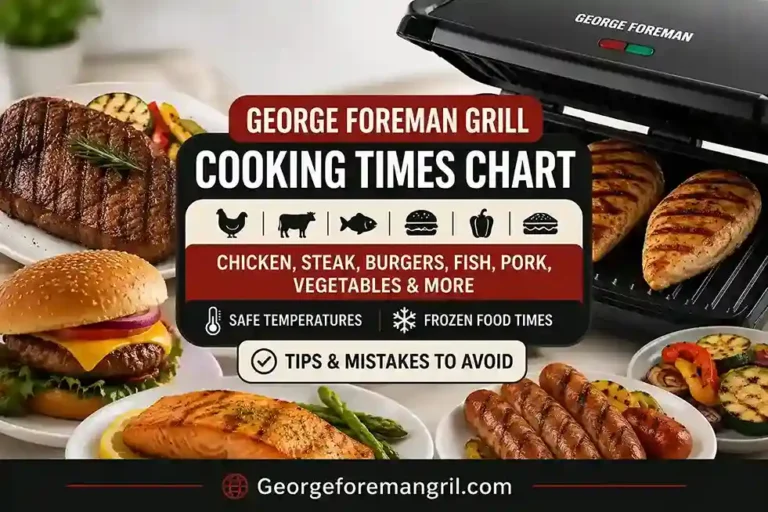
A juicy American hamburger is simple in theory, but a few small mistakes can leave it dry, unevenly cooked, or cold in the center. George Foreman Grills also cook from both sides at once, so standard outdoor-grill cooking times do not always apply. Patty thickness, grill model, lid pressure, and internal temperature all affect the result.
This guide shows you how to make a classic American burger on a George Foreman Grill from start to finish. You will learn how to choose the beef, shape even patties, estimate cooking time, check doneness with a food thermometer, add cheese, toast the buns, store leftovers, and avoid the most common burger problems.
Quick Summary
Choose 80/20 Beef
Use 80/20 ground beef if you prefer a richer, juicier burger.
Shape Even Patties
Make each patty about ½ to ¾ inch thick for more even cooking.
Preheat the Grill
Preheat the grill according to the instructions for your specific model.
Do Not Press the Lid
Lower the lid gently and do not push down on the burgers.
Start Checking Early
Begin checking fresh 4-ounce patties after about 4 minutes.
Times Are Estimates
Cooking time varies with patty thickness, weight, starting temperature, and grill model.
Cook to 160°F
Ground beef should reach 160°F in the center before serving.
Use a Thermometer
Check the center with a food thermometer instead of relying on meat color.
Rest Briefly
Rest the burgers briefly before assembling and serving them.
What Is a Classic American Hamburger?
A classic American hamburger is a ground-beef patty served inside a split bun. Common toppings include lettuce, tomato, onion, dill pickles, ketchup, yellow mustard, and mayonnaise. There is no single official topping combination. American hamburgers vary by restaurant, region, and personal preference. Some are simple, with beef, onion, mustard, and pickles. Others include cheese, bacon, grilled onions, or a special burger sauce.
The basic combination usually includes:
A ground-beef patty
A hamburger bun
Simple seasoning
Fresh or pickled toppings
One or more condiments
Hamburger vs. Cheeseburger
Hamburger
A hamburger is made with a ground-beef patty served in a bun. Cheese is not required.
Cheeseburger
A hamburger becomes a cheeseburger when cheese is added to the cooked beef patty.
Cheese Choices
American cheese melts easily, but cheddar, Swiss, pepper jack, and provolone can also be used.
Safe Temperature
Adding cheese does not change the safe cooking temperature. Ground beef should still reach 160°F in the center.
Ingredients for an American Hamburger
American Hamburger Ingredients
For the Burger Patties
1 pound ground beef
1 teaspoon salt
½ teaspoon black pepper
½ teaspoon garlic powder, optional
½ teaspoon onion powder, optional
For Serving
4 hamburger buns
4 slices American cheese, optional
Lettuce leaves
Tomato slices
Thinly sliced onion
Dill pickle slices
Ketchup
Yellow mustard
Mayonnaise
You can change the toppings to suit your taste. Keeping the base recipe simple allows the beef and grilled flavor to remain the main focus.
Best Ground Beef for Juicy Hamburgers
Ground chuck labeled 80/20 is a popular choice for homemade hamburgers.
The label means the beef is approximately:
80% lean
20% fat
Fat adds flavor and can help a burger stay moist during cooking. Some rendered fat will drain away on a sloped contact grill. Leaner beef, such as 85/15 or 90/10, can also be used. Because it contains less fat, it may become dry if overcooked. Begin checking lean patties early and remove them once they reach a safe internal temperature.
Avoid adding too much liquid to the meat. Large amounts of Worcestershire sauce, ketchup, or other wet ingredients can make soft patties harder to handle.
Do Hamburger Patties Need Egg or Breadcrumbs?
No. A basic American hamburger does not need egg or breadcrumbs. Ground beef can hold together when it is shaped gently into a patty. Egg and breadcrumbs create a more tightly bound texture and are more common in meatloaf-style mixtures or specialty burger recipes. Use binders only when a specific recipe calls for them.
Classic American Burger Toppings
Classic American Burger Toppings
Classic Toppings
Lettuce
Sliced tomato
White or red onion
Dill pickles
Ketchup
Yellow mustard
Mayonnaise
American cheese
Popular Additions
Bacon
Grilled onions
Jalapeños
Relish
Barbecue sauce
Burger sauce
Avocado
Topping Tip:
There is no required topping combination. Choose a few that work well together and avoid adding too many wet ingredients, which can make the bun soggy.
Best Buns and Sauces
Best Buns and Sauces
Bun Choices
Soft hamburger buns are a classic choice. Sesame buns, potato buns, and brioche-style buns can also work well.
Choose the Right Size
Choose a bun close to the size of the cooked patty. Beef patties shrink during cooking, but the amount varies with fat, moisture, temperature, and cooking time.
Classic Sauce
Ketchup and yellow mustard make a simple, classic American burger combination.
Creamy Sauce
Mayonnaise adds a mild, creamy layer without overpowering the beef.
Burger Sauce
Burger sauce adds a richer taste and works well with pickles, onions, and cheese.
Barbecue Sauce
Barbecue sauce adds a sweeter, smoky flavor to the finished hamburger.
Sauce Tip:
Use a moderate amount of sauce. Too much can make the bun soggy and cause the burger layers to slide apart.
How to Make an American Hamburger on a George Foreman Grill
A George Foreman Grill is a contact grill. The lower and upper plates heat the burger at the same time, so cooking may be faster than on a skillet or one-sided outdoor grill.
Exact instructions vary by model. Follow your grill manual for preheating, capacity, plate care, and cleaning.
How to Make an American Hamburger on a George Foreman Grill
Step 1: Preheat the Grill
Position the drip tray correctly if your model uses one.
Close the lid and preheat the grill according to the instructions for your model. Some models use a ready light to show when preheating is complete.
Do not assume that every George Foreman Grill requires exactly 5 minutes. Preheating systems differ between models.
Starting with a properly preheated grill helps the patties begin cooking evenly. Make sure the cooking plates are clean before adding raw meat.
Step 2: Shape and Season the Patties
Divide 1 pound of ground beef into four equal portions. Each portion will weigh about 4 ounces.
Shape each patty to be:
½ to ¾ inch thick
Even in thickness
Close to the size needed for your buns
Do not squeeze, knead, or repeatedly reshape the meat. Heavy handling can create a firmer texture.
Season both sides with salt and black pepper. Garlic powder and onion powder are optional.
Keep raw ground beef refrigerated until you are ready to cook it. Wash your hands with soap and water after handling raw meat, and keep raw-meat utensils and plates away from cooked burgers and ready-to-eat toppings.
Step 3: Cook the Hamburgers
Place the patties on the lower grill plate in a single layer.
Do not overload the grill. Leave enough room for the lid to close correctly and for each patty to make proper contact with the plates.
Lower the lid gently. Do not push down with your hand.
Cook with the lid closed unless your model instructions say otherwise. Because both plates heat the patties, routine flipping is usually unnecessary on a standard contact grill.
Begin checking a typical 4-ounce patty after about 4 minutes. Continue cooking until the center reaches the safe internal temperature.
Step 4: Check the Internal Temperature
Cooking time is only an estimate. A food thermometer is the best way to check whether a ground-beef burger has reached a safe temperature.
Ground beef should reach 160°F in the center.
For a thin patty, insert an instant-read thermometer from the side so the sensing area reaches the center. If the patty is thick or uneven, check a second location.
Do not depend only on:
Brown color
Pink color
Clear juices
Grill marks
Firmness
A fixed number of minutes
Ground beef can turn brown before it reaches 160°F. It can also remain pink after reaching a safe temperature. Clean the food thermometer before and after use according to its care instructions.
Step 5: Add Cheese and Rest the Burgers
Once the burger reaches 160°F, remove it from active cooking heat.
If you want a cheeseburger, place a slice of cheese on the hot patty. Keep the cheese from touching the upper grill plate.
Depending on the model, you can remove the patty to a clean plate and let its heat soften the cheese. You can also follow any cheese-melting method given in your grill manual.
A 2-to-3-minute rest is optional. Ground beef does not have a USDA-required rest period after reaching 160°F, but a short rest can make the burger easier to assemble.
Step 6: Toast the Buns and Assemble
If your grill manual allows bread to be toasted on the cooking plates, place the buns cut-side down after raw-meat cooking is finished.
Use a suitable, clean cooking surface and clean utensils when handling the buns and finished burgers.
Toast the buns briefly and watch them closely. Exact timing depends on the grill temperature and type of bun.
Simple assembly order:
Bottom bun
Sauce
Lettuce or pickles
Cooked burger patty
Cheese, if using
Tomato
Onion
More sauce, if desired
Top bun
Contact Grill vs. Skillet vs. Outdoor Grill
George Foreman Grill
Cooks both sides at once. Flipping is usually unnecessary, and cooking may be faster.
Skillet
Cooks mainly from below. Burgers need flipping and can develop a stronger flat crust.
Outdoor Grill
Uses heat mainly from below with open airflow. Timing depends on grill temperature and heat level.
Main Safety Check
For every cooking method, ground beef should reach 160°F in the center.
How Long to Cook Hamburgers on a George Foreman Grill
A fresh 4-ounce hamburger may take roughly 4 to 7 minutes on a preheated George Foreman Grill, but there is no single cooking time that works for every grill and every patty. Thickness, weight, beef composition, starting temperature, and grill model can all change the cooking time. Use 160°F in the center as the final safety check.
George Foreman Burger Cooking Guide
Thin Beef Patty
Begin checking after 3–5 minutes. Cook the center to 160°F.
Medium Beef Patty
Begin checking after 4–7 minutes. Cook the center to 160°F.
Thick Beef Patty
Begin checking after about 6 minutes. Continue until it reaches 160°F.
Turkey or Chicken Patty
Cooking time varies. Ground poultry must reach 165°F.
Times are estimates. Patty thickness, weight, starting temperature, and grill model can change the cooking time.
These are general estimates, not guaranteed cooking times.
A thin 4-ounce patty will usually finish before a thick 6-ounce patty. Different George Foreman models may also heat and preheat differently. Check early, then continue cooking as needed.
Flipping and Pressing Burgers
Do You Need to Flip Burgers?
Usually, no. A standard George Foreman contact grill cooks the top and bottom of the patty at the same time, so flipping is normally unnecessary when both plates make proper contact. Follow your model instructions if its cooking design differs.
Should You Press Down on the Lid?
No extra pressure is normally needed. Lower the lid gently and let the upper plate contact the burger. Pushing down hard can flatten the patty and squeeze out more liquid and rendered fat.
Simple Rule
Let the grill plates do the cooking. Do not use the lid like a burger press.
How to Keep George Foreman Burgers Juicy
Contact grills cook both surfaces at once. That makes them convenient, but it also means a burger can continue past its ideal texture if you leave it on the grill too long.
Use these tips for a better result.
How to Keep George Foreman Burgers Juicy
Choose Beef With Some Fat
An 80/20 blend is a popular choice for a richer burger. Leaner beef can still work but may dry out faster if overcooked.
Keep the Meat Cold
Keep raw ground beef refrigerated until close to cooking time. It does not need to reach room temperature before cooking.
Handle the Beef Gently
Shape each patty only until it holds together. Heavy mixing and repeated pressing can create a firmer texture.
Make Even Patties
Keep each patty even in thickness and make burgers in the same batch similar in size for more consistent cooking.
Preheat Before Cooking
Preheat according to your grill manual. This gives you a more consistent starting point for cooking.
Do Not Press the Lid
The upper grill plate already provides contact. Extra pressure can flatten the burger and push out more moisture.
Start Checking Early
For a standard 4-ounce patty, begin checking at about 4 minutes. Actual cooking time can vary by thickness and grill model.
Stop Cooking at 160°F
Ground beef should reach 160°F in the center. Remove the burger once it reaches this safe internal temperature.
Let It Rest
A 2-to-3-minute rest is optional but can make the burger easier to handle and assemble. No separate USDA rest period is required after ground beef reaches 160°F.
Common Mistakes to Avoid
Common Burger Mistakes to Avoid
Using Beef That Is Too Lean
Very lean beef can dry out if overcooked. Check the center early and remove the burger once it reaches 160°F.
Making Uneven Patties
Thin edges may overcook before a thick center is ready. Shape each patty as evenly as possible.
Making Patties Too Thick
Thick patties need more time for the center to reach 160°F. About ½ to ¾ inch is a practical starting range for many contact grills.
Pressing Down on the Lid
Hard pressure is unnecessary. It can flatten the patty and push out more moisture and rendered fat.
Cooking Only by Time
Cooking time changes with patty size, meat temperature, and grill model. Use a thermometer to confirm doneness.
Judging Doneness by Color
Color is not a reliable safety test. A burger may look brown before 160°F or remain pink after reaching it.
Overcooking the Burgers
Contact grills heat both sides, so burgers may cook faster than skillet or outdoor-grill recipes suggest. Begin checking early.
Adding Cheese Too Soon
Cheese may stick to the upper plate. Add it after the burger is cooked and keep it away from the hot top plate.
Crowding the Grill
Too many patties can stop the lid from sitting correctly. Cook in batches when the grill surface is full.
Can You Cook Frozen Hamburgers on a George Foreman Grill?
Whether you should cook a burger directly from frozen depends on the grill model and the frozen product.
Check both the appliance manual and the package instructions. If either one requires thawing first, follow that direction. For more even cooking, raw frozen ground-beef patties can be thawed safely in the refrigerator. Do not thaw raw ground beef on the kitchen counter.
Regardless of the starting state, the center must reach:
160°F for ground beef
165°F for ground chicken
165°F for ground turkey
Cooking time for a frozen patty can be much longer than for a fresh or thawed patty, so do not use the fresh-burger time chart as a fixed guide.
Burger Storage and Reheating Guide
Refrigerate Promptly
Refrigerate cooked burgers within 2 hours. If the surrounding temperature is above 90°F, refrigerate them within 1 hour.
Store Separately
Keep cooked patties in a clean, covered container. Store buns, lettuce, tomato, and sauces separately for better reheating results.
Refrigerator Storage
Cooked hamburgers can generally be stored in the refrigerator for 3 to 4 days.
Reheat to 165°F
Reheat leftover burger patties until the center reaches 165°F. Check with a food thermometer.
Choose a Reheating Method
Use a suitable grill, skillet, oven, or microwave. Follow the instructions for the appliance you use.
Avoid Reheating Fully Assembled Burgers
Reheat the patty separately when possible. Lettuce and tomato do not reheat well, and the bun can become soggy.
What to Serve With an American Hamburger
What to Serve With an American Hamburger
Classic Sides
French fries
Potato wedges
Onion rings
Dill pickles
Corn on the cob
Baked beans
Fresh and Lighter Sides
Coleslaw
Grilled vegetables
Potato salad
Green salad
For a lighter meal:
Serve the hamburger with a green salad or grilled vegetables.
Instructions
Instructions
1. Prepare the Grill
Position the drip tray if your model uses one. Preheat the grill according to the model instructions.
2. Divide the Beef
Divide the ground beef into four equal portions of about 4 ounces each.
3. Shape the Patties
Shape each portion into an even patty about ½ to ¾ inch thick.
4. Season
Season both sides with salt, black pepper, and any optional dry seasonings.
5. Place on the Grill
Arrange the patties on the preheated lower grill plate in a single layer.
6. Close the Lid
Lower the lid gently without pressing down on the burgers.
7. Begin Checking
Begin checking standard 4-ounce patties after about 4 minutes. Actual cooking time can vary.
8. Check the Temperature
Insert a food thermometer from the side into the center of each patty.
9. Cook to 160°F
Continue cooking until each ground-beef patty reaches 160°F in the center.
10. Transfer the Burgers
Move the cooked burgers to a clean plate that has not held raw meat.
11. Add Cheese
Add cheese, if desired, and allow the heat from the burger to soften it.
12. Rest Briefly
Rest the patties for 2 to 3 minutes if desired before assembling the burgers.
13. Toast the Buns
Toast the buns according to your grill model instructions, using a clean cooking surface.
14. Assemble
Add the cooked patties, sauces, cheese, and your favorite toppings to the buns.
15. Serve
Serve the American hamburgers while warm.
Frequently Asked Questions
Usually, no. A standard contact grill heats the top and bottom of the patty at the same time, so routine flipping is unnecessary. Follow your model manual if its design or instructions differ.
Yes. A safely cooked ground-beef patty can sometimes remain pink, while another patty may turn brown before it is safe. Use a food thermometer and cook ground beef to 160°F rather than judging doneness by color.
No. A basic American hamburger can be made from ground beef and seasoning without a binder. Egg and breadcrumbs are optional ingredients used in some specialty recipes and create a more tightly bound texture.
Many contact grills can toast bread, but check your model instructions first. Toast buns only on a suitable, clean cooking surface after raw-meat handling is finished. Watch them closely because timing varies by grill and bun type.
Common causes include overcooking, very lean beef, thin patties, and extra pressure on the lid. Use an even patty, begin checking early, and remove ground beef when the center reaches 160°F.
Yes, but it changes the texture and can make patties softer or harder to handle, especially if you add a lot of liquid. For a simple American hamburger, season the beef and add onion and sauce as toppings. If you mix ingredients into raw beef, cook the entire patty to 160°F.
About ½ to ¾ inch is a practical starting range for many contact grills. The best thickness also depends on the grill’s lid design and capacity. Keep patties even so the center cooks at a similar rate throughout.
Conclusion
A classic American hamburger on a George Foreman Grill comes down to a few reliable checks: use evenly shaped patties, preheat according to your grill model, avoid pressing the lid, and check the center with a food thermometer instead of relying on color or a fixed cooking time. Ground beef should reach 160°F, while cooking times can vary between patties and grill models. With careful raw-meat handling and early temperature checks, you can make a simple, juicy burger without guessing when it is ready.