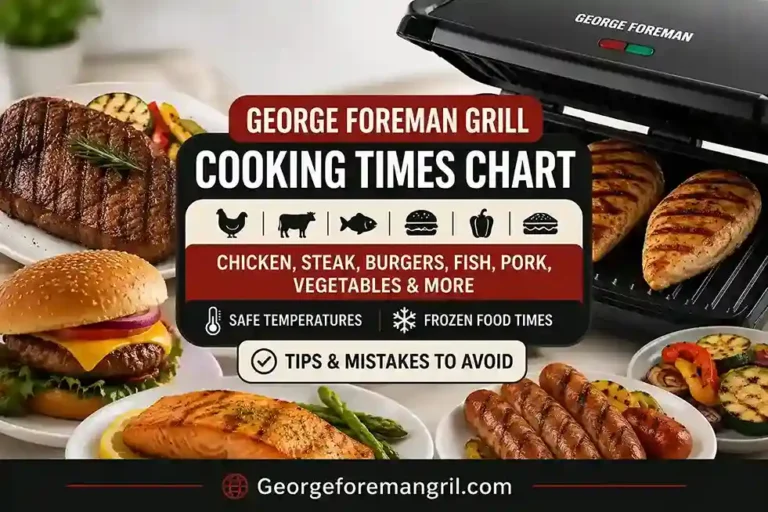
Small sliders cook fast. That is useful when you need a quick meal, but it also makes them easy to overcook. Many online recipes give times for gas grills, charcoal grills, or flat-top griddles. Those instructions may not work the same way on a George Foreman Grill because its upper and lower plates heat both sides of the patty together.
Fresh beef sliders that weigh about 2 ounces and measure close to 1/2 inch thick often need around 4 to 6 minutes total on a fully preheated George Foreman Grill. Treat this as a starting estimate rather than a fixed rule. This guide explains how long to grill sliders, how patty size affects the time, when to check the center, and how to cook beef, turkey, chicken, and frozen sliders safely.
How Long to Cook Sliders on a George Foreman Grill?
Fresh beef sliders that weigh about 2 ounces and measure around 1/2 inch thick will often cook in about 4 to 6 minutes total on a preheated George Foreman Grill. You normally do not need to flip them. The upper and lower grill plates cook both sides at once.
There is no single cooking time that works for every slider or every George Foreman model. Patty thickness, meat temperature, grill size, heating strength, and the number of patties on the plates can all change the result.
Begin checking the sliders near the lower end of the estimated range. Ground beef should reach 160°F (71°C) in the center. Ground turkey and chicken should reach 165°F (74°C). USDA advises using a food thermometer because color and cooking time alone cannot confirm that ground meat is safe.
Check after 3–4 minutes
Cook to 160°F
About 4–6 minutes total
Cook to 160°F
About 5–7 minutes total
Cook to 160°F
Check after 4 minutes
Cook to 165°F
Check after 4 minutes
Cook to 165°F
Follow package directions
Verify the center temperature
The official manual for some George Foreman 2-serving and 5-serving models includes a turkey-slider recipe. It uses eight 2-ounce patties and gives a cooking time of 4 to 5 minutes, with a recipe endpoint of 170°F. USDA’s safe minimum for ground poultry is 165°F, though following a product recipe that uses a higher endpoint is also safe.
The same George Foreman manual lists 6 to 8 minutes for 4-ounce burgers that are about 1/2 inch thick. Smaller 2-ounce patties may finish sooner, but you should confirm this on your own grill with a thermometer.

Ingredients for George Foreman Grill Sliders
1 teaspoon salt
½ teaspoon black pepper
8 slider buns
4 slices of cheese, cut in half
Pickles, optional
Thinly sliced onion, optional
Lettuce, optional
Tomato, optional
Ketchup, mustard, or burger sauce
Onion powder
Smoked paprika
Worcestershire sauce
Best Meat for Juicy Sliders
Ground beef with an 80/20 lean-to-fat ratio works well for sliders. The fat adds flavor and helps protect the small patties from drying out.
Leaner ground beef can still work. You will need to watch it more closely because it usually contains less fat and may feel dry if cooked too long.
Ground turkey and ground chicken are also suitable. Since many poultry mixtures are lean, avoid leaving them on the grill after they reach the safe temperature. No matter which meat you use, do not taste the raw mixture. Raw ground meat can contain harmful bacteria.
Best Slider Patty Size and Thickness
A 2-ounce patty is a common size for an individual burger slider. One pound of meat will make about eight patties of this size.
Aim for patties that are:
- About 2 ounces each
- Close to 1/2 inch thick
- Slightly wider than the slider buns
- Equal in size and thickness
Patty thickness affects cooking time more than width alone. A thick 2-ounce patty may take longer than a flatter patty with the same weight.
A kitchen scale gives the most consistent results. You can also divide one pound of meat into eight equal portions by eye. Handle the beef gently. Pressing or mixing it too much can create a firm, dense texture.
How to Make Sliders on a George Foreman Grill
This method is for fresh, raw beef sliders. Adjust the final temperature when using poultry.
Place the drip tray under the front edge of the grill.
Plug in the George Foreman Grill and preheat it according to the manual for your model. On some models, a green light shows that the grill has preheated.
Note: The ready light relates to the grill’s heating system. It does not tell you when the meat is cooked.
Divide 1 pound of ground beef into eight equal portions. Shape each portion into a patty about ½ inch thick and slightly wider than the buns.
Avoid packing the meat tightly. Use only enough pressure to help each patty hold its shape.
Food safety: Wash your hands with soap and water after touching raw meat. Clean any utensils and work surfaces that contacted it.
Season both sides of each patty with salt and black pepper. Add other dry seasonings if desired.
Avoid adding too much liquid. Very wet patties can be harder to shape and may brown less evenly. Season shortly before grilling.
Place the patties on the preheated lower plate. Leave a small gap between each patty so the upper plate can rest evenly.
Grill capacity depends on:
- Grill model
- Plate size
- Patty diameter
- Space between patties
Cook in batches when needed.
Lower the lid until the upper cooking plate rests on the sliders.
Do not push down hard. Let the floating hinge adjust naturally to the thickness of the patties.
Begin checking fresh 2-ounce beef sliders after about 3 to 4 minutes. They may need another minute or two.
Cooking time can change based on:
- Patty weight and thickness
- Starting meat temperature
- Fat percentage
- Grill model and plate temperature
- Number of patties
- Preheating
- How often the lid is opened
Check every batch instead of assuming each one will need exactly the same time.
Insert a food thermometer through the side of the thickest patty and aim for the center. Do not let the probe touch the hot grill plate.
Ground turkey: 165°F (74°C)
Ground chicken: 165°F (74°C)
If the temperature is too low, close the grill and cook for another 30 to 60 seconds before checking again.
Once the sliders reach the correct temperature, add the cheese. Do not press the upper grill plate directly onto it.
You can:
- Add cheese after removing the patties
- Cover the warm patties loosely for a minute
- Hold the grill lid above the cheese without touching it, if your model allows this safely
Let the sliders rest for about 2 minutes before placing them on the buns. The 3-minute USDA safety rest for whole cuts does not apply to ground beef cooked to 160°F.
Do You Flip Sliders on a George Foreman Grill?
You normally do not need to flip sliders on a George Foreman Grill. The upper and lower cooking plates heat both sides at the same time. A gas or charcoal grill usually heats the burger mainly from below, which is why outdoor recipes tell you to flip each patty.
This difference also affects how you read cooking times.
That is 6 minutes total on a one-sided heat source. It does not mean the same slider will always need 6 minutes on a two-sided contact grill. Use outdoor grill times only as general context. Follow the instructions for your appliance and check the center temperature.
How to Tell When Sliders Are Done
Use a food thermometer to check the center of the thickest slider. Do not depend on appearance or cooking time alone.
USDA research found that about one in four hamburgers can turn brown before reaching a safe internal temperature. Color is therefore not a dependable safety test. Time tells you when to start checking. Temperature tells you when the meat is ready to remove.
Safe Internal Temperature for Beef Sliders
Safe Internal Temperature for Turkey and Chicken Sliders
Can You Cook Frozen Sliders on a George Foreman Grill?
Some frozen sliders can be cooked on a George Foreman Grill, but the package instructions should be your first guide. Cooking time varies widely between products.
- Patty thickness
- Meat type
- Raw or fully cooked
- Fat content
- Added fillers
- Manufacturer cooking method
- Read the package label.
- Check whether the patties are raw or fully cooked.
- Confirm that contact-grill cooking is allowed.
- Follow any stated cooking and standing times.
- Check the center temperature before serving.
Raw frozen poultry sliders: 165°F (74°C)
Common Mistakes When Cooking Sliders
Small patties cook quickly, so minor errors can have a large effect.
Pro Tips for Juicy George Foreman Sliders
What to Serve with Grilled Sliders
George Foreman sliders work well for lunch, dinner, parties, or game-day meals. Pair them with your favorite sides and toppings.
- French fries
- Potato wedges
- Sweet potato fries
- Onion rings
- Coleslaw
- Potato salad
- Green salad
- Pickles
- Grilled vegetables
- Corn on the cob
- Cheddar cheese
- American cheese
- Pepper jack
- Pickles
- Lettuce
- Tomato
- Raw onion
- Caramelized onion
- Ketchup
- Mustard
- Mayonnaise
- Burger sauce
How to Store and Reheat Leftover Sliders
George Foreman Grill Sliders Recipe
- George Foreman Grill
- Drip tray
- Digital food thermometer
- Mixing bowl
- Kitchen scale, optional
- Clean plate for cooked sliders
- Separate plate for raw patties
Patty thickness: About ½ inch
First temperature check: After 3–4 minutes
Safe beef temperature: 160°F (71°C)
Rest time: About 2 minutes
- Place the drip tray under the front of the grill.
- Preheat the George Foreman Grill according to the manual for your model.
- Divide the ground beef into eight portions of about 2 ounces each.
- Shape each portion into a patty about ½ inch thick.
- Season both sides with salt and black pepper.
- Place the patties on the preheated lower plate with space between them.
- Close the lid gently without pressing it down.
- Begin checking the sliders after about 3 to 4 minutes.
- Insert a food thermometer through the side into the center of a patty.
- Continue cooking in short intervals until the beef reaches 160°F (71°C).
- Remove the patties to a clean plate.
- Add cheese and let it soften from the heat of the meat.
- Rest the sliders for about 2 minutes.
- Serve on slider buns with your chosen toppings.
Frequently Asked Questions
Final Thoughts
Fresh 2-ounce beef sliders that are close to 1/2 inch thick often need about 4 to 6 minutes total on a preheated George Foreman Grill, but the thermometer reading matters more than the timer. Keep the patties equal in size, avoid pressing the lid, and start checking early. Cook ground beef to 160°F and ground turkey or chicken to 165°F. These steps give you a safer and more repeatable result while lowering the chance of serving dry sliders.